
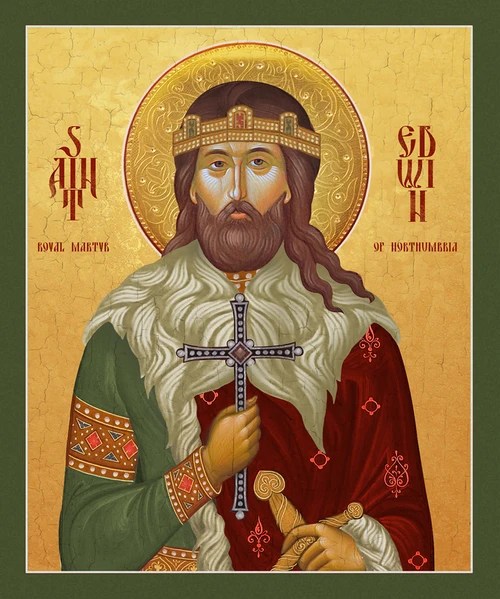

(Top) Saint-King Edwin of Northumbria, and (above) fall foliage along Penns Creek in our region.
Today we commemorate, alongside the Holy Fathers of the Seventh Ecumenical Council, a few notable saints of the British Isles, includng Martyr Edwin of Northumbria, who reposed in the early 600s, killed in a battle with rival kings known to be anti-Christian. Such early saints of the British Isles remind us of how close the Orthodox Christian Tradition runs to us in ancient roots, even in the history of our English-speaking land far from Russia and the Holy Land. The Venerable Bede, an ancient English scholar living a century after King Edwin wrote of how an adviser encouraged the king originally to embrace Christianity. According to Bede, the King’s adviser spoke thus:
“The present life of man, O king, seems to me, in comparison with that time which is unknown to us, like to the swift flight of a sparrow through the room wherein you sit at supper in winter amid your officers and ministers, with a good fire in the midst whilst the storms of rain and snow prevail abroad; the sparrow, I say, flying in at one door and immediately out another, whilst he is within is safe from the wintry but after a short space of fair weather he immediately vanishes out of your sight into the dark winter from which he has emerged. So this life of man appears for a short space but of what went before or what is to follow we are ignorant. If, therefore, this new doctrine contains something more certain, it seems justly to deserve to be followed.”[25]
Bede summarized Edwin’s reign as Christian King of Northumbria in this way:
“It is told that at the time there was so much peace in Britannia, that whenever King Edwin’s power extended, as is said proverbially right up to today, even if a woman with a recently born child wanted to walk across the whole island, from sea to sea, she could do so without anyone harming her.”
In the Liturgy we ask, “For a Christian ending to our life, painless, blameless, peaceful, and a good defense before the dread judgment seat of Christ, let us ask of the Lord.”
May St. Edwin King be both a model and an intercessor for us today, together with the Holy Fathers of the Seventh Ecumenical Council whom we also commemorate today. They lived the virtue of courage in standing up for the holy icons when they had been banned. Many became martyrs and confessors after the resumption of iconoclasm for a time after the Council. But their witness lives on. Together with Martyr King Edwin they remind us of how an awareness of our own short life on earth can move us to make the best of it with God’s help.
Our modern Father among the saints, John of Kronstadt, lived a life of devotion to the faith in the world. Like many saints who were not monastic but lived in the world, he brought with him to his life in Orthodoxy some of the same qualities of devotion, hard work, ans attentiveness to the faith. He cared not only for Liturgy and prayer but also caring for the poor, the sick, the imprisoned. He wrote a prayer showing how each of us in the world with families and jobs can still like Martyr-King Edwin live a life for Christ. The prayer for confession speaks to me and perhaps all of us as Orthodox Christians of the need to keep our hearts open to God in the world. Let us attend.
“I, a sinful soul, confess to our Lord God and Savior Jesus Christ, all of my evil acts which I have done, said or thought from baptism even unto this present day.
I have not kept the vows of my baptism, but have made myself unwanted before the face of God.
I have sinned before the Lord by lack of faith and by doubts concerning the Orthodox Faith and the Holy Church; by ungratefulness for all of God’s great and unceasing gifts; His long-suffering and His providence for me, a sinner; by lack of love for the Lord, as well as fear, through not fulfilling the Holy Commandments of God and the canons and rules of the Church.
I have not preserved a love for God and for my neighbor nor have I made enough efforts, because of laziness and lack of care, to learn the Commandments of God and the precepts of the Holy Fathers.
I have sinned: by not praying in the morning and in the evening and in the course of the day; by not attending the services or by coming to Church only half-heartedly, lazily and carelessly; by conversing during the services, by not paying attention, letting my mind wander and by departure from the Church before the dismissal and blessing.
I have sinned by judging members of the clergy.
I have sinned by not respecting the Feasts, breaking the Fasts, and by immoderation in food and drink.
I have sinned by self-importance, disobedience, willfulness, self-righteousness, and the seeking of approval and praise.
I have sinned by unbelief, lack of faith, doubts, despair, despondency, abusive thoughts, blasphemy and swearing.
I have sinned by pride, a high opinion of my self, narcissism, vanity, conceit, envy, love of praise, love of honors, and by putting on airs.
I have sinned: by judging, malicious gossip, anger, remembering of offenses done to me, hatred and returning evil for evil; by slander, reproaches, lies, slyness, deception and hypocrisy; by prejudices, arguments, stubbornness, and an unwillingness to give way to my neighbor; by gloating, spitefulness, taunting, insults and mocking; by gossip, by speaking too much and by empty speech.
I have sinned by unnecessary and excessive laughter, by reviling and dwelling upon my previous sins, by arrogant behavior, insolence and lack of respect.
I have sinned by not keeping my physical and spiritual passions in check, by my enjoyment of impure thoughts, licentiousness and unchastity in thoughts, words and deeds.
I have sinned by lack of endurance towards my illnesses and sorrows, a devotion to the comforts of life and by being too attached to my parents, children, relatives and friends.
I have sinned by hardening my heart, having a weak will and by not forcing myself to do good.
I have sinned by miserliness, a love of money, the acquisition of unnecessary things and immoderate attachment to things.
I have sinned by self-justification, a disregard for the admonitions of my conscience and failing to confess my sins through negligence or false pride.
I have sinned many times by my Confession: belittling, justifying and keeping silent about sins.
I have sinned against the Most-holy and Life-creating Mysteries of the Body and Blood of our Lord by coming to Holy Communion without humility or the fear of God.
I have sinned in deed, word and thought, knowingly and unknowingly, willingly and unwillingly, thoughtfully and thoughtlessly, and it is impossible to enumerate all of my sins because of their multitude.
But I truly repent of these and all others not mentioned by me because of my forgetfulness and I ask that they be forgiven through the abundance of the Mercy of God.”
Brothers and sisters, let us keep this spirit of confession in our heart each day of all the year, that each day even out and about in the world, we may renew our baptism, and feel Jesus Christ reborn and resurrected in our life, even in this beautiful autumn season in northern Appalachia. May the autumn tree colors touch our hearts to remind us both of the beauty of God’s glory and the nearness of mortality in the fall toward winter, and to do our best to do something beautiful for God by His grace, like the Martyr King Edwin and the Fathers of the Seventh Ecumenical Council. Even so the Gospel readings remind us today of how our Lord Jesus Christ gave compassion and healing in the world even as He led to the heights of theology in his prayer that we may all be one as He and the Father are one. Glory to God for all things!
***
The Reading from the
Holy Gospel according to Luke,
§30 [7:11-16]
At that time, Jesus went into a city called Nain; and many of His disciples went with Him, and many people. Now when He came nigh to the gate of the city, behold, there was a dead man being carried out, the only son of his mother, and she was a widow. And many people of the city were with her. And when the Lord saw her, He had compassion on her and said unto her, ‘Weep not.’ And He came and touched the bier, and those who bore him stood still. And He said, ‘Young man, I say unto thee, arise.’ And he that was dead sat up and began to speak. And He delivered him to his mother. And there came a fear on all, and they glorified God, saying, ‘A great prophet is risen up among us’; and, ‘God hath visited His people.’
Holy Gospel according to John,
§56 (17:1-13]
At that time Jesus lifted up his eyes to heaven, and said, ‘Father, the hour is come. Glorify Thy Son, that Thy Son also may glorify Thee, as Thou hast given Him power over all flesh, that He should give eternal life to as many as Thou hast given Him. And this is life eternal: that they might know Thee, the only true God, and Jesus Christ whom Thou hast sent. I have glorified Thee on the earth; I have finished the work which Thou gavest Me to do. And now, O Father, glorify Thou Me with Thine own Self with the glory which I had with Thee before the world was. I have manifested Thy name unto the men whom Thou gavest Me out of the world. Thine they were, and Thou gavest them to Me, and they have kept Thy Word. Now they have known that all things whatsoever Thou hast given Me are of Thee. For I have given unto them the Words which Thou gavest Me; and they have received them and have known surely that I came out from Thee, and they have believed that Thou didst send Me. I pray for them; I pray not for the world, but for them whom Thou hast given Me, for they are Thine. And all Mine are Thine, and Thine are Mine, and I am glorified in them. And now I am no more in the world, but these are in the world, and I come to Thee. Holy Father, keep through Thine own name those whom Thou hast given Me, that they may be one, as We are. While I was with them in the world, I kept them in Thy name. Those that Thou gavest Me I have kept, and none of them is lost, but the son of perdition, that the Scripture might be fulfilled. And now come I to Thee, and these things I speak in the world, that they might have My joy fulfilled in themselves.’