
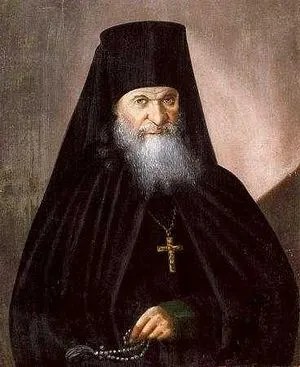
An homily from St. John’s Russian Orthodox Mission Church in Winfield, PA, for the Sixteenth Sunday after Pentecost, 7535/2026, by Priest Paul Siewers.
Although we are a mainly English-speaking mission parish in America, there are certain Slavic and Greek words that resonate with special meaning for us.
One is podvig, an ascetic self-sacrifice. Another, phronema, or way of life in Orthodoxy. Then there is sobornost, meaning mystical unity, the full Orthodox sense of catholic. Lesser known but important is govenie, meaning the ascetic weekly preparation for Communion and the spiritual accountability and humility involved. And still another lesser known but important is the word you may not have heard, smirrennomudrie. This means “humility of wisdom.”
And that humility of wisdom, smirrennomudrie, is a part of the Orthodox way of life especially associated with one of the saints whom we commemorate today, the Holy Elder Macarius of Optina Monastery, who reposed on this date in 1860. I.V. Kireyevsky, a nineteenth-century Russian Orthodox philosopher, became a disciple of Elder Makarius, and helped produce many of the books of the fathers and saints that came out of Optina monastery under the direction of the elder during that period. Their relationship bore fruit because Kireyvsky after a conversation with the elder wrote a long letter to him with many questions that he as an intellectual had about the faith. But his letter crossed in the mail with a letter from the elder answering those questions, even though he had not yet received Krireyvsky’s letter. Clairvoyantly the holy elder seems to have known the questions already. Kireyevsky was persuaded that here was wisdom beyond academic learning.
The Holy Elders of Optina of course are important for our Russian Orthodox Church Abroad tradition, especially to American converts through the influence of their lives and writings on the brotherhood of Blessed Seraphim Rose. But they are important influencers for good on world Orthodoxy as a whole, too. And that in many ways is through their “humility of wisdom.”
Elder Macarius helped encourage this by his emphasis on preserving, renewing, and circulating the writings of earlier Church fathers and saints. He helped to make Optina monastery in the 19th century a center for such publications and scholarly effort, but not in a Western scholastic way. Always the emphasis was on how we must learn from and through the Church fathers in Orthodox Tradition, guided by the Holy Spirit, not through our own individualistic rationalism, as became the norm in Western religion in modern times.
Humility of wisdom became a basis for keeping Russian Orthodoxy alive, and renewing, in the diaspora after the Revolution, and also in the later flowering of English-language translations of the fathers and saints that we see today in our work in the Orthodox mission to America, glory to God! Elder Maciarius’ emphasis on the humility of wisdom runs against the grain of our modern ethos of using knowledge for self-assertion, comfort, and worldly power, the fruits of which may be seen in AI.
Kireyevsky wrote, “The task of Russian philosophy is not to reject Western thought, but to supplement it with what is revealed in higher spiritual vision—the living experience of ‘higher knowledge’—in which the wholeness of spirit, lost in the Fall and impaired by the triumph of logical thought in Western Christianity, is recovered.”
Let us hear directly the words of Holy Elder Macarius from letters to his spiritual children (these quotations and other information about him here are drawn from the book on the elder published in English by the St. Herman of Alaska Brotherhood Press, in their Optina Elders series:
He writes: “Acknowledging yourself to be a sinner you must not despair, but humble yourself more and marvel at God’s love for mankind, for He forebears you and awaits your conversion and repentance…. Are you a sinner? Do not despair… Your weapon against the devil is your forebearance…. If you sin every day, then you must repent every day. Have you decayed today because of sin? Renew yourself by repentance….
“Imagine a spark falling into the sea: can it withstand the sea and continue to glow? How small is a spark in contrast to the sea, and how small is sin in contrast to God’s love for mankind! … God’s love for mankind is unlimited.”
“The beginning of all these temptations is pride. A man imagines that he is living piously, not judging his own sinfulness at all, but sometimes even judging others—then the Lord allows the enemy to lay snares for him. Be attentive to your own way of life, check your conscience, and you will always come, however unwillingly, to the conviction that you have not yet fulfilled even one of the Lord’s commandments as a Christian should….
“In order to deliver yourself from these falls, you must acxquire humility. As far as the sinful thoughts at church or while praying at home are concerned, since they are not caused by you, but by the enemy, you don’t have to be troubled. Try not to dwell on these thoughts, but turn to God instead with the prayer: ‘Lord Jesus Christ, Son of God, have mercy on me, a sinner!”
“….try to live piously, not judging anyone, loving all. In all worldly conflicts, blame yourself and try to forgive he other. If someone offens you in something, then think that God has allowed it in order to test your Christian patience. Think more often of the greatness of God and your own wretched nothingness. Be attentive to your own doings, and not allow yourself thoughts of your own worth, like the Pharisee, but repeat more often the prayer of the Publican. Read spiritual books, and subscribe to spiritual magazines, this will keep you occupied, and will strengthen you in spiritual activity.”
St. Macarius’ letters are peppered with parallels to writings of the saints and of Holy Scripture, in keeping with his grace-filled virtue of “humility of wisdom.”
The antidote for artificial intelligence lies in smirennomudrie, humility of wisdom, in Holy Orthodox Tradition. For in Orthodox Christianity, intelligence is personal and an expression of grace–and wisdom, understanding, counsel, and knowledge are four of the great biblical seven gifts of the Holy Spirit. They are not designed to self-medicate us into passiveness, but rather to arouse us into what Dostoevsky called active love, as the Gospel reading today calls us to do, in Christ.
Brothers and sisters, may our intelligence not be artificial, but personal, graceful, expressive of love, supernaturally natural in Christ– in short smirennomudrie, humility of wisdom, as shown to us by our father among the saints Elder Macarius of Optina and his legacy. Glory to God for all things!