

In May on our Church calendar we move from Pascha into the Ascension to Pentecost, and touch on the opening of the Apostles Fast.
This is an “in-between” time appropriate for us mortals seeking redemption from our Lord, marking our growth from our baptismal roots in His Resurrection, into branches God willing of the Vine of the Body of Christ, His Church.
The Resurrection of our Lord blooms for us in the founding of His Church at Pentecost, symbolized in the green leafy branches we place in our Church following Russian tradition, but fitting for the Northern Appalachian Penn’s Woods in which we live.
Between Pascha and Pentecost, He ascended to sit in human form at the right hand with the Father. What a transfigurative honor for us if we empty ourselves in Him; what a great gateway for our salvation. As St. Cyprian of Carthage noted, he who would have God as Father must have the Church as Mother. So we in our community and personal lives bloom and grow in the grace of God’s uncreated light energizing us.
From this vantage point given to us by His grace in the Church calendar, we can reflect both back on our Lord’s Passion Week and Resurrection, and forward to the missionary ascetic struggling of the Apostles Fast. Our Lord’s sacrifice–to whom?
St. Gregory the Theologian (from Fr. Demetrios Carellas):
“It is clear that the Father accepts Him – though He neither asked for this, nor needed it – because of the divine plan, and because the human being must be sanctified by the humanity of God, so that God Himself might set us free; conquer the tyrant by force; and lead us back to Himself through the mediation of the Son, Who also planned this to the honor of the Father — to Whom it is manifest that He yields all things. This much we have said of Christ, and the greater part will be revered by silence. But the bronze serpent [Numbers 21:4-9] is hung up to oppose the biting serpents, not as a type [a representation] of the One Who suffered for us but as an antitype. It saves those who look at it, not because they believe it is alive but because it has been killed; and kills [or mortifies] with itself the powers subject to it — being destroyed, as it indeed deserves. And what is a fitting funeral oration for it from us? ‘O death where is your sting? O Hades where is your victory?’ [I Cor. 15:55] By the Cross you have been overthrown, by the Giver of life, you have been put to death. You are lifeless, dead, motionless, without activity, even if you [death] who are lifted high on a pole, keep the form of a serpent(*).” [Part 21 of 28]
Here the Theologian offers insight into a great mystery, as Fr Demetrios’ grandson Evangelos explains from the Greek: “In his masterful allegorical exegesis, Saint Gregory, like many of his fellow Church Fathers, identifies the Old Testament brazen serpent with the Cross of Christ. ‘It saves those who look at it,’ the faithful Christians, ‘not because they believe it is alive,’ as in early heretical beliefs that could not believe God was capable of suffering, and thus held that the suffering and death of Christ was a kind of illusion or phantom, ‘but because it has been killed.’ We cannot have the Resurrection without the Passion. The powers subject to it, that is, the biting serpents, Death and Satan, are likewise slain with Christ by the Cross, however, they do not rise with Him. It is here that the subject Saint Gregory has in mind seems to shift, as he addresses a funeral oration not for Christ, but for those slain powers that do not rise with Him.”
So the Cross becomes for us in this season of the Ascension, Pentecost, and the Apostles, a witness to death on which depends the Resurrection–the death of our old selves as we grow forth, the seed God willing having fallen into the earth and died, so the wheat of the Bread of Life can grow through us, however unworthily.
This month we see further growth as a mission parish: Our first funeral, and our first burial in our consecrated Orthodox cemetery. This past year has seen our first catechisms, baptisms, chrismations, and wedding in our new Temple, which is dedicated to the Lord by His presence with us in the Eucharist and the prayers of our Church family of saints in the icons around us.
Appropriately to this new growth, we are training a new cadre of altar servers and readers of the Hours from among our newly enlightened ones baptized during the Pascha Season. We look forward to a missionary Orthodox film series in the community starting this summer season (stay tuned for details), together with outreach-fundraising food-sale projects, and more downtown missionary work in the communities of our region. And we rededicate ourselves to the ascetic ethos of the Orthodox Church in the Apostles Fast and our prayers (see the article on the Lestovka prayer ladder below), a Fast that we uphold on the ancient Church calendar even as it virtually disappears on the “modern” secular calendar adopted by some unfortunately.
But while we ask the Holy Ghost to keep us zealous in spirit for the faith, we must also seek humility from God for our mission work. As the Righteous Seraphim Rose (who our Council of Bishops blessed for the process of glorification recently) put it: “It is later than you think. Hasten therefore to do the work of God.”
Glory to God for all things!
(Note: This newsletter follows the Church calendar dating, not the civil calendar, so May 1 here is May 14 in secular dating; doubled numbers below, with a slash mark between, indicate first the Church calendar and then the civil calendar date.)
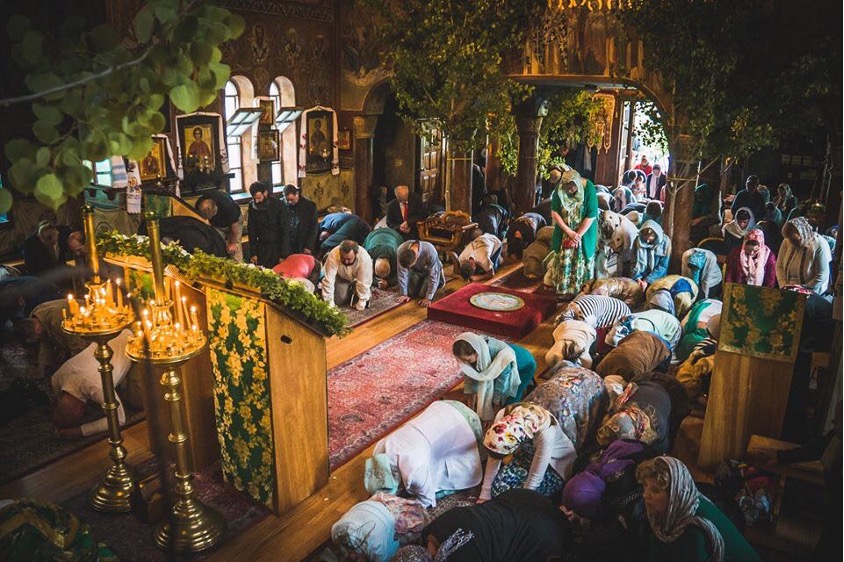
Above: Pentecost at Holy Trinity Monastery Cathedral, Jordanville, NY.
Weekly Services and Programs
Saturday Vigil, 4:30 p.m. Sunday Divine Liturgy 10 a.m. (Hours 9:40).
Regular programming: Orthodoxy Online, Saturday 10 to 11 a.m. (check with Priest Paul for link), and Orthodox Bible Study Sunday 2:30 p.m., Bucknell Barnes & Noble Cafe.
Confessions at Vigil, early Sunday, and by appointment.
May Calendar, Special Dates
May 1/14. Psalter reading for the repose of John Sam, 8 p.m.
May 2/15. Funeral and burial service for John Sam, 10 a.m.
May 4/17. Pascha procession after Sunday coffee hour in downtown Sunbury.
May 11/24. Sunday outreach procession through downtown Lewisburg after coffee hour.
May 7/20. Leave-taking of Pascha and Ascension Vigil, 6:30 p.m.
May 8/21. Feast of the Ascension, Liturgy 10 a.m. (Hours 9:40)
May 18/31. Feast of Pentecost, Liturgy 10 a.m. followed by Kneeling Vespers
May 26/June 8. Apostles Fast Begins.
MINISTRY/MISSION WORK UPDATES
Orthodoxy Online Class: The Online Orthodox class is discussing the Long Catechism of St. Philaret of Moscow together with the Catechism by Metropolitan Antony of ROCOR. This is a helpful weekly discussion not only for catechumens, inquirers, and new Orthodox Christians, but for those who are “experienced” as well, as a refresher. We meet Saturdays from 10 to 11 a.m., usually at Bucknell.zoom.us/my/Kentigern/.
Orthodox Bible Study: We continue our weekly Bible Study, currently exploring the Wisdom of Sirach in light of the Church Fathers.
Prison Ministry: Priest Paul continues his regular visits to pray and meet with interested inmates at the Muncy SCI, God willing starting to bring Communion to the Orthodox with assistance from Reader Nicholas.
Sisterhood of St. Olga of Alaska update: Mary (Sally) has kindly invited the sisterhood to meet for a spring tea at her home in Williamsport. Hopefully that will be scheduled soon. Watch for other projects.
Brotherhood of St. Alfred the Great update: Thanks to members of the brotherhood for taking up landscaping work and also we hope an outdoor retreat this summer.
University Ministry: We hope to welcome a new Orthodox Christian student entering Susquehanna University to our parish, as well as a new cadre of Orthodox students at Bucknell, where Fr. Paul is Orthodox chaplain. Let’s prepare for renewed outreach and support for college students in the area this fall.
Beautification of Temple: Please pray that the beautification of the exterior of our temple may be completed as a vehicle of outreach to our community, in installing the dome. Once the installation is made, we hope to proceed with plans for the permanent iconostasis, for which we already have the design.
A few ongoing reminders from our Church Tradition:
–Please dress respectfully for Church services. Men should wear long pants and long-sleeved shirts, women long skirts or dresses below the knees with shoulders covered, and women should wear head coverings at services but especially when coming up for communion.
–Attending Vigil, at least Vespers, is part of preparation for Holy Communion. If you cannot attend, then please ask Fr. Paul for guidance on prayers at home or away that you can say, and see him for a blessing early Sunday before taking Communion.
–As we enter this month into the Apostles Fast, please remember that confession should be made at least once each major fasting session, including now this new one. But preferably more frequently–once every two months is a good rule of thumb, or more often if you have committed any sin that would be an obstruction to receiving communion. If in doubt, partake of this healing Mystery of the Church!
–In preparing for Communion, remember the preparation prayers and fasting preparation. Check with Fr. Paul if you have questions. Preparation is about accountability and focus, not legalism, but it represents us making a sacrifice for God in our own lives and circumscribing our self-will for Him.
–If you will be absent for a good cause and visiting another Church to receive Communion, please receive Father Paul’s blessing in advance; other Priests appreciate knowing that your “home” parish Priest has blessed you to receive elsewhere as a visitor, and that you are prepared. Be sure also to contact the “host” Priest with whom you will be visiting in advance. Receiving is a blessed gift, not an entitlement, for all of us. Glory to God!
Contact Info
Father Paul, 570-863-9039, priestpauls@pm.me
www.stjohnthewonderworker.com
This Month’s Prayer Encouragement: The Lestovka Prayer Ladder
(Condensed from St. Demetrios Orthodox Monastery in Virginia, https://virginiamonks.org/products/old-believer-lestovka-leather-prayer-rope)
Every Orthodox Christian should have and use a prayer rope. Elder Ephraim of blessed memory called it “our weapon” in spiritual warfare; just as in secular life, some gun enthusiasts may “conceal carry” for security, as Orthodox Christians this is our way to focus our prayer in spiritual defense that is always needed. One type of Orthodox prayer rope is the Lestovka, described below.
Made of leather, handcrafted glass beads, or fabric the Lestovka or “Ladder” is a type of prayer rope used in Russia before the arrival of the Greek knotted prayer rope in the 18th century. It is still used today by pious Orthodox Christians, and has been historically used by various saints of the Moscow Patriarchate in modern times ( St. Seraphim of Vyritsa during the Soviet Union (20th century), St. Seraphim of Sarov (18th century), Alexandra (Melgunova), foundress of Diveyevo Convent (18th century), St. Sergius of Radonezh (14th century), St. Anna of Kashin (14th century), St. Ilya of Murom monastic of the Kyiv Caves (12th century), St. Erasmus of Kiev Caves (12th century), St. Mark the Mute of Sarov (18th century), Righteous Juliania, etc).
The ladder outwardly resembles a flexible staircase and symbolizes in the ancient Slavic Christian tradition the ladder of spiritual ascent from the earth to Heaven. It should be carried reverently in your front pocket (not in the back pocket), and can be also stored when not in use on your prayer corner.


The Lestovka has four lapostki (leaves or flaps), symbolizing the four Evangelists. The stitching around the leaves symbolizes the teaching of the Gospel. Sealed between the leaves are seven movable pieces, as tokens of the seven Great Mysteries of the Church. Where the Lestovka is joined together there are three steps at each end, and on the Lestovka itself are three more steps, for a total of nine, which stands for the nine orders of angels, and for the nine months during which the most pure Mother of God carried in her womb the Infant Who is before all ages.
The empty space after between the juncture represents the earth. Then there are twelve counters (babochki, rungs, steps, beads or loops), signifying the twelve Apostles who walked on the earth with the Lord. Then there are thirty-eight counters for the weeks in which the Theotokos carried Christ in her womb. The next thirty-three counters represent the thirty-three years the Lord walked the earth. And the seventeen counters symbolize the seventeen prophets who prophesied concerning Christ.

Like other Prayer Ropes, any repeated prayer can be said, however the one used most often is the Jesus Prayer.
The traditional (but not required) way to pray the Lestovka:
First three and Last three steps:
Alleluia Alleluia glory to thee o God x3 (prostration)
The empty space after the first three and last three steps:
Lord have mercy (bow)
The steps:
Lord Jesus Christ have mercy on me
1st through 3rd big steps on main “ladder”:
Remember me; O Lord; when thou comest into thy kingdom (prostration)
At the end of the Lestovka after all other prayers have been said:
God be merciful to me a sinner (bow)
Thou hast created me, O Lord have mercy on me (bow)
The meaning of these short prayers is always the same: a person acknowledges God as Almighty, realizing his unworthiness before Him, understands his sinfulness and spiritual weakness, and asks the Most Merciful God for forgiveness of all his sins; bringing forth the worthy fruit of repentance.
At the end of the prayer rule on the lestovka, it is proper to take the flaps in ones left hand and pray: “Lord, have mercy” (three times). Then you move to the other side and praise God: “Glory to the Father, and to the Son, and to the Holy Spirit, now and ever, and unto the ages of ages. Amen.”
When praying on the lestovka, one should also not forget about bodily feats – prostrations to the ground and waist. Prostrations are made on the Alleluia and large steps (9 prostrations). When performing prostrations, it is necessary if possible to use a prayer rug or do the prostration so that the lestovka does not hit the ground (by placing it into your front pocket or holding it in your closed fist).
Here is an example of a prayer rule for praying 10 lestovka: the first seven ladders are to Jesus Christ (they can be easily counted by moving), the eighth ladder is to the Guardian Angel, the ninth ladder is to John the Baptist, and the tenth is to the Most Holy Theotokos.
Information on how to use the Lestovka can be found in the following article:
Edinovertsi’s Treasure: The Rule of Home Prayer / OrthoChristian.Com
The following video from Fr. Deacon Phillipexplains the Lestovka further:
(187) Old Believer Lestovka explained – YouTube
This documentary explains the symbolism and history behind the Lestovka (auto-translate can be turned on to English and the translation is understandable)
https://www.youtube.com/watch?v=eVOeNbd-K0Y
The following video shows a lestovka being made at Valaam Monastery:
(187) Учимся делать лестовку (русские четки) вместе | Валаамский монастырь – YouTube