
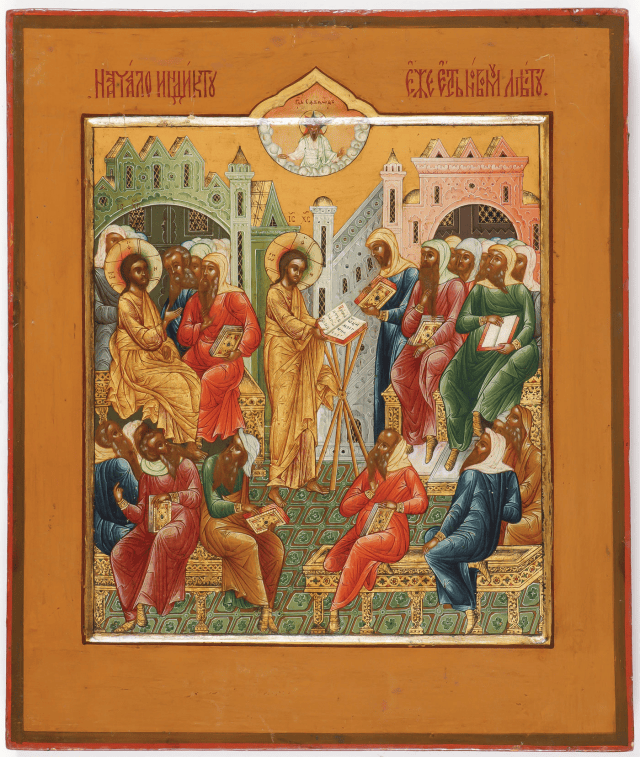
Homily from St. John’s by Priest Paul Siewers, Fourteenth Sunday after Pentecost, the New Year.
The Gospel for our Orthodox New Year today according to tradition marks the start of our Lord Jesus Christ’s public ministry. This is the real point of turning over a new leaf, a new beginning, just as folklore associates the civil New Year with resolutions and the new year. This is a good time to commit ourselves anew at the Church New year to daily prayer, to traditional fasting, to upping our game in being in Church for Vigil and weekday major feasts, and confession, to giving alms and helping those who are alone and in need. All this involves what the Gospel reading means by preaching the acceptable year of the Lord, which means the ongoing jubilee of life in the Body of Christ, His Church.
Our Lord’s reading of the prophecy of Isaiah on this day reminds us of resolutions to make, with God’s grace: Preach the Gospel to the poor, heal the brokenhearted, preach deliverance to the captives, recovering of sight to the blind, to set at liberty those bruised, and again to preach the acceptable year of the Lord. With those words, according to tradition, our Lord began His public ministry and with it the jubilee era of the Church—according to our Tradition, the symbolic thousand years or millennium of Revelation. The thousand years can be seen as symbolizing the law of God squared or fulfilled, the Ten Commandments times 10, in the Orthodox Church as the full realization of biblical Israel through Jesus Christ’s gift to us of His Body the Church.
So what resolutions, friends? Preach the Gospel to the poor in spirit. Can we resolve to bring new people to Church with us—family, friends, neighbors, inquirers, people from work. How long has it been and how many have we brought with us in the past year? Let’s all of us, starting with myself more than anyone, resolve to bring people to Church and into the Church with God’s help. Let your light shine. That’s how we also can heal the brokenhearted. Bringing people to Church, visiting shut-ins and those in nursing homes and in prison and even also those students on campus away from home. Do you know we have a developing prison ministry at our Church as well as a campus ministry, and a ministry to those in hospital or at home for medical reasons? We do. You can help. Please talk with me. How about the parish sisterhood and the brotherhood as ways of including those who are alone or apart in various ways, and involving new people? All that can involve preaching deliverance to the captives, too—captives like all of us of sin and worldly cares.
I was baptized today 26 years ago, the most unworthy new Orthodox Christian ever. If it had not been for many a hand pulling me up out of the depths of sin, I would not have made it to my baptism, sinner that I was. And throughout the years that followed, it took grandparents, and spiritual family, and dedicated priests and monastics and even bishops to give me a hand along, letting the uncreated light of God shine in their caring. To set at liberty those who are bruised means giving those wounded by life a sight and a taste of the beauty of salvation in the Orthodox Church, as I so unworthily received, and as I and each of us need still to experience in the Eucharist.
Resolutions in the new year as mentioned can also mean making more of a priority each day for prayer, and each week for worship, including Vigil and mid-week major feasts. For so we proclaim following Jesus the acceptable year of the Lord, and proclaim the full motherhood of the Orthodox Church in nurturing the growth of each of us. In this new year’s day also, much of the Orhtodox world recognizes a special time to honor the gift of God’s creation, and to be good care keepers of our fellow people and our fellow creatures. Traditional fasting in the Church is designed for us to remember to be less carnivorous in our lives, to live less richly and more humbly, and to make more of our resources available for alms-giving. On traditional Orthodox fast days we avoid more intelligent forms of life for a vegan diet with shellfish, to remind us that with the Fall of Adam and Eve, whom we also commemorate with Creation today, came carnivority, the survival of the fittest. We can learn to be less carnivorous toward each other spiritually, less carnivorous physically in Creation, by living more humbly in lifting up others.
But what does it mean that this is now 7534? That’s what Orthodox Christians in the Christian Roman Empire, known in the modern West as Byzantium, settled on for their chronography from the Bible. They measured years in the Septuagint Greek Old Testament back from Christ, knowing that the modern dating of Christ’s birth is inaccurate, with which much scholarship agrees, that our Savior was born in Bethlehem a few years before our current year zero. Even time in our Lord’s Church each day is based on Hours of Prayer and the daily services, with the daily clock started at sunset, in the evening, like our new year in the twilight of the year, leaning into autumn.
Our distinct calendar and clock reminds us of sacred time. We can live in the Church as Christians in a time that is not a time of the rat race, of secular commercialism, of violent dog-eat-dog carnivority. God’s uncreated energies or grace reach us right here and now, through and in the mysteries of the Church. They can shine from us with the light of Christ as we seek to empty ourselves in Him. That means that we live amid not only our cellphone time but also a beyond time that belongs to God. This lifts us up from our troubles when we think there is no way out of a situation, no way out of a burden, no way to be forgiven of our sin and wrongdoing. A day with the Lord is as a thousand years, and a thousand years as one day. So even today, which in ancient times marked the start of a new tax year, we are reminded of all God gives us and all we owe Him, and how through His Son He has erased our debt if we but open our hearts and strive to transform our lives with His grace, to live in Him, Christ.
Our Lord revealed to Moses that the evening and the morning were day. And so too, it is in the evening of the year, as we head toward winter, that the Church year begins. For the growing hours of darkness on earth give us quiet time to anticipate and pray and look for the birth of our Lord at His Nativity near the winter solstice. And then we have the joy of anticipation of Pascha for which we prepare in Great Lent, a word that means springtime. Our spiritual sprouts develop and grow, like perennial flowers, beneath the surface, in God’s good earth with His grace.
The Church new year reminds us to give our all to God, including our sense of time and priorities. Like the ultimate example of Christ standing in the synagogue and reading from the prophet, and saying “This day is this fulfilled,” it reminds us to stand as witnesses and even if God wills martyrs. It also means that we feel connected to each other in Church, to the apostles, saints, and prophets of the calendar and biblical chronology, and most of all to God our Creator and daily sustainer. Our days, and our hours, are His. St. Simon Stylites, who we commemorate today, stood out in the most literal way! He lived atop a column in his ascetic practice, a holy fool, yet a spiritual elder consulted by many from peasants to royalty. The Gospel reminds us, whatever our situation, that our Lord seeks us to come to Him, the Good Shepherd. He says, I will give you rest. So too there is refreshment at new year’s, a reminder of priorities to help us set aside worldly care, like Simon.
But on the civil year of 2025 in our country there is much unrest. Don’t be deceived. It is spiritual warfare that is behind what the New York Times described Friday based on interviews across the country as the deeply unsettled condition of America. Seven years ago we held a centennial memorial service for the Holy Royal Martyrs of Russia. A historian noted that almost 20,000 public figures were assassinated by revolutionaries during the last 25 years of imperial rule in Russia, an average of two or three a day, while under the Tsars the number of political executions of alleged revolutionaries was miniscule by comparison. That wave of revolutionary political violence was a sign of the times then.
As Christians we are under order today, both to watch for the spiritual signs of the times, to be martyrs or witnesses for the truth even unto death, and to protect the children or vulnerable in the Church. Some Church Fathers say the time between our age and the Second Coming and Final Judgment appears flexible because it is in God’s time, and God responds to the prayers of the faithful for mercy and more time to save more souls, to bear witness, and to protect the vulnerable to save more souls. Brothers and sisters, in this Church year let us pray for that, too, while we also join the Evangelist John in saying, come, Lord Jesus. A blessed new year to all! Glory to God!
***
Sunday’s Gospel Readings:
The Reading from the Holy Gospel according to Luke,
§13 [4:16-22]
At that time, Jesus came to Nazareth where He had been brought up. And as His custom was, He went into the synagogue on the Sabbath day and stood up to read. And there was delivered unto Him the book of the prophet Isaiah. And when He had opened the book, He found the place where it was written: ’The Spirit of the Lord is upon Me, because He hath anointed Me to preach the Gospel to the poor. He hath sent Me to heal the brokenhearted, to preach deliverance to the captives, and recovering of sight to the blind, to set at liberty those who are bruised, to preach the acceptable year of the Lord.’ And He closed the book, and He gave it again to the minister and sat down. And the eyes of all those who were in the synagogue were fastened on Him. And He began to say unto them, ‘This day is this Scripture fulfilled in your ears.’ And all bore Him witness and wondered at the gracious words which proceeded out of His mouth.’
Holy Gospel according to Matthew,
§89 [22:1-14]
The Lord said this parable: ‘The Kingdom of Heaven is like unto a certain king, who made a marriage for his son. And he sent forth his servants to call them that were bidden to the wedding, and they would not come. Again he sent forth other servants, saying, ‘Tell them that are bidden, ‘Behold, I have prepared my dinner; my oxen and my fatlings are killed, and all things are ready. Come unto the marriage.’‘ But they made light of it and went their ways, one to his farm, and another to his merchandise, and the remnant took his servants and treated them spitefully and slew them. But when the king heard thereof he was wroth, and he sent forth his armies and destroyed those murderers and burned up their city. Then said he to his servants, ‘The wedding is ready, but they that were bidden were not worthy. Go ye therefore into the highways, and as many as ye shall find, bid to the marriage.’ So those servants went out into the highways, and gathered all together as many as they found, both bad and good, and the wedding was furnished with guests. And when the king came in to see the guests, he saw there a man who did not have on a wedding garment. And he said unto him, ‘Friend, how camest thou in hither not having a wedding garment?’ And he was speechless. Then said the king to the servants, ‘Bind him hand and foot and take him away, and cast him into outer darkness: there shall be weeping and gnashing of teeth.’ For many are called, but few are chosen.’
Holy Gospel according to Matthew,
§43 [11:27-30]
The Lord said to His disciples: ‘All things are delivered unto Me by My Father, and no man knoweth the Son, but the Father; neither knoweth any man the Father, save the Son, and he to whomsoever the Son will reveal Him. Come unto Me all ye that labour and are heavy laden, and I will give you rest. Take My yoke upon you and learn of Me, for I am meek and lowly in heart, and ye shall find rest unto your souls. For My yoke is easy, and My burden is light.’