
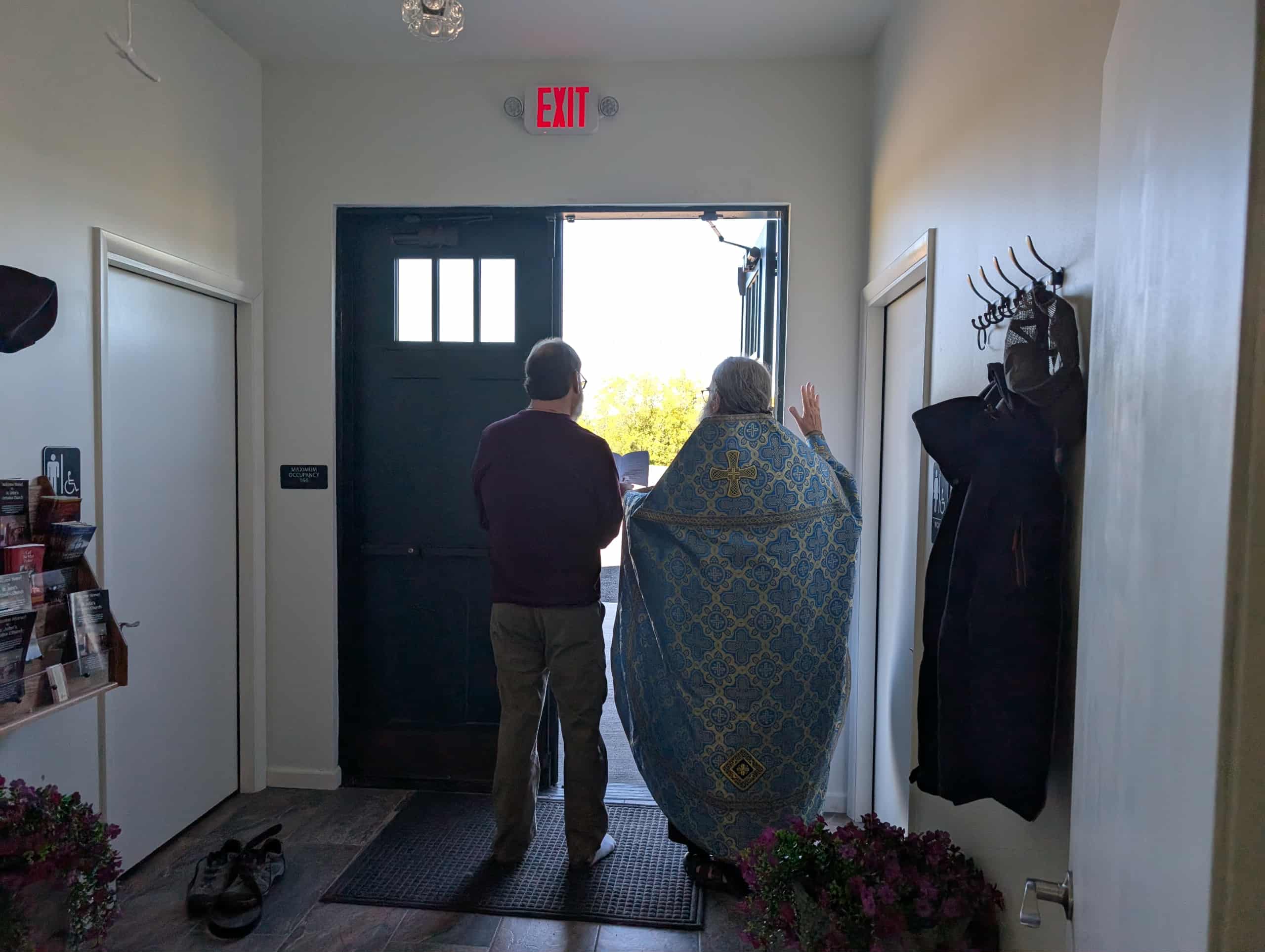
Our sixth current catechumen is received into the journey to baptism today at St. John’s, glory to God!
Homily from St. John’s Russian Orthodox Mission Church in Winfield, PA, for Sunday, Aug. 18, 7533 (8/31/25 on the civil calendar), by Priest Paul Siewers. Glory to God!
Today’s Gospel readings operate on many dimensions, as Holy Scripture does.
For one, the rich young man, while earnest about his interest in spirituality, is entrapped in comfort. First, this is an issue for most of us in America, which is the richest country in the world and enjoys unprecedented prosperity due to natural bounty, our relative separation from past wars by oceans, technological success, and hard work in a culture that until recently prided itself on faith and freedom.
We should remember in that regard that pride is a sin, and we need a humility month more than a pride month for sure!
But that said, for the most part, even poor Americans have access to comforts undreamed of by the richest of our ancestors not long ago and throughout history, and that access is envied by most of the people in the world who are much poorer and often desperately try to come to America for such comforts. That means that even if we struggle and have much to complain about, we are really more in the profile of the rich man than we may want to admit.
As usual, also, in relation to that, our Lord Jesus Christ would like us to consider economics, which literally means the law of the household, from a non-worldly standpoint. God gifts us Creation and its bounty for free. During the Dormition season, we have had following Orthodox tradition blessings of honey, apples, grapes and other fruit, herbs and flowers, and nuts, to remind us of this. The Dormition season, in which we still participate now in the After feast of Dormition, is really Orthodox Christian Thanksgiving season. So when we approach economics, our Lord wants us, as he says in the Sermon on the Mount, to seek first the Kingdom of God, and all things needed will then be added unto us.
This is why He can tell the young man to give away all his riches. For as the other Gospel reading today reminds us, even the hairs of our heads are numbered by God, who also knows even the career of each little sparrow. We need to remember that we are not here for worldly success but for service to God and from Him to our neighbor. This is why Jesus teaches us to pray, “Give us this day our daily bread.” That means in Greek also “our super-essential bread,” which includes first and foremost the spiritual nourishment given to us in the Eucharist by Christ, the Bread of Life, in Holy Communion.
We can also think of this, in the aftermath of the Dormition Fast, in relation to how fasting helps to free us from worldliness. In the 20th century there were two great English-novels offering critiques of totalitarian rules. One was 1984 by George Orwell, which detailed a society controlled by technological oppression. It was modeled on Communism, which so severely persecuted and oppressed the Orthodox Church. The other famous dystopian novel of that time was Brave New World by Aldous Huxley. It portrays a totalitarian society controlled by drugs, entertainment media and narratives, sex, and bioengineering. The control was by comfort. This was based on and prophetic of how we can lose even secular freedom through riches, and is inspired not by Communism but by capitalism without God. The Communist regime in Russia produced an army of new martyrs, saints who intercede for us, and who are especially close and dear to us as spiritual family in the Russian Orthodox Church Outside of Russia. Their sacrifice for the faith and rejection of worldly success speak to us today in a society that is increasingly dominated by technological control and mindless careerism, isolating people and depriving life of meaning. Holy New Martyrs of Russia pray to God for us in our mission to America today! They show us the way out of the subtler bondage of so-called freedom today. Their riches, like the spiritual wealth recommended by Jesus to the young men, lay in spiritual sacrifice, and not in material wealth and success, and their holiness enables them to help us with their prayers today.
Similarly, what Jesus recommends to the young man is to empty himself in Christ, and thus to be able to fulfill Jesus’ New Commandment. That New Commandment is to love our neighbor more than ourself. Great love, our Savior says, has no man than this, that he lay down his life for his friends. Brothers and sisters, let us follow our Lord’s New Commandment, and save lives for Him by our evangelizing work for the Orthodox Church, in our families, among our friends, in our neighborhoods and communities. The need is great, and there is no other way we can help others so well as by sharing the Orthodox Gospel as we sacrifice ourselves and our wealth and our worldly success for our neighbor.
I know an older couple, some of you may know them as well, an elderly husband and wife, who live on a mountain in the Poconos a little more than an hour from here. They are blessed with children and grandchildren. But they have given their lives to the service of the Orthodox Church. This priest and his wife, both converts from long ago, live in a little house a short walk from a great and growing Orthodox monastery. They gave up any hopes of material riches and success to dedicate themselves day in and day out to the cycle of services in the Church week upon week, which they serve as priest and presvytera. They help many through their friendship and uplifting conversations and prayers day upon day. Brothers and sisters, let us find their fulfillment in the faith, in Christ, and let us without any regret give up our world riches and lives in the service of our Savior. Even if we have families are in the world, their example shows us that we can do this, too.
St. John Chrysostom writes that the obtaining of true glory cancels the punishment of the sin of passion such as greed desiring earthly glory that can never be secure. He writes,
“…with respect to their [financial] gains men are wont to suffer harm more than anything from the disease of covetousness–they become at least the subjects of many tricks, and of small gains make great losses, wherefore this saying has prevailed even to be a proverb; and as to the voluptuous man likewise, his passion becomes a hindrance to the enjoyment of his pleasure…. Knowing then all these things, let us lay down these passions, that we may not both pay a penalty here, and there be punished without end. Let us become lovers of virtue. For so both before reaching the kingdom we shall reap the greatest benefits here, and when we are departed there we shall partake of the eternal blessings; unto which God grant we may all attain by the grace and love towards man of our Lord Jesus Christ, to whom be glory and might world without end. Amen.”