
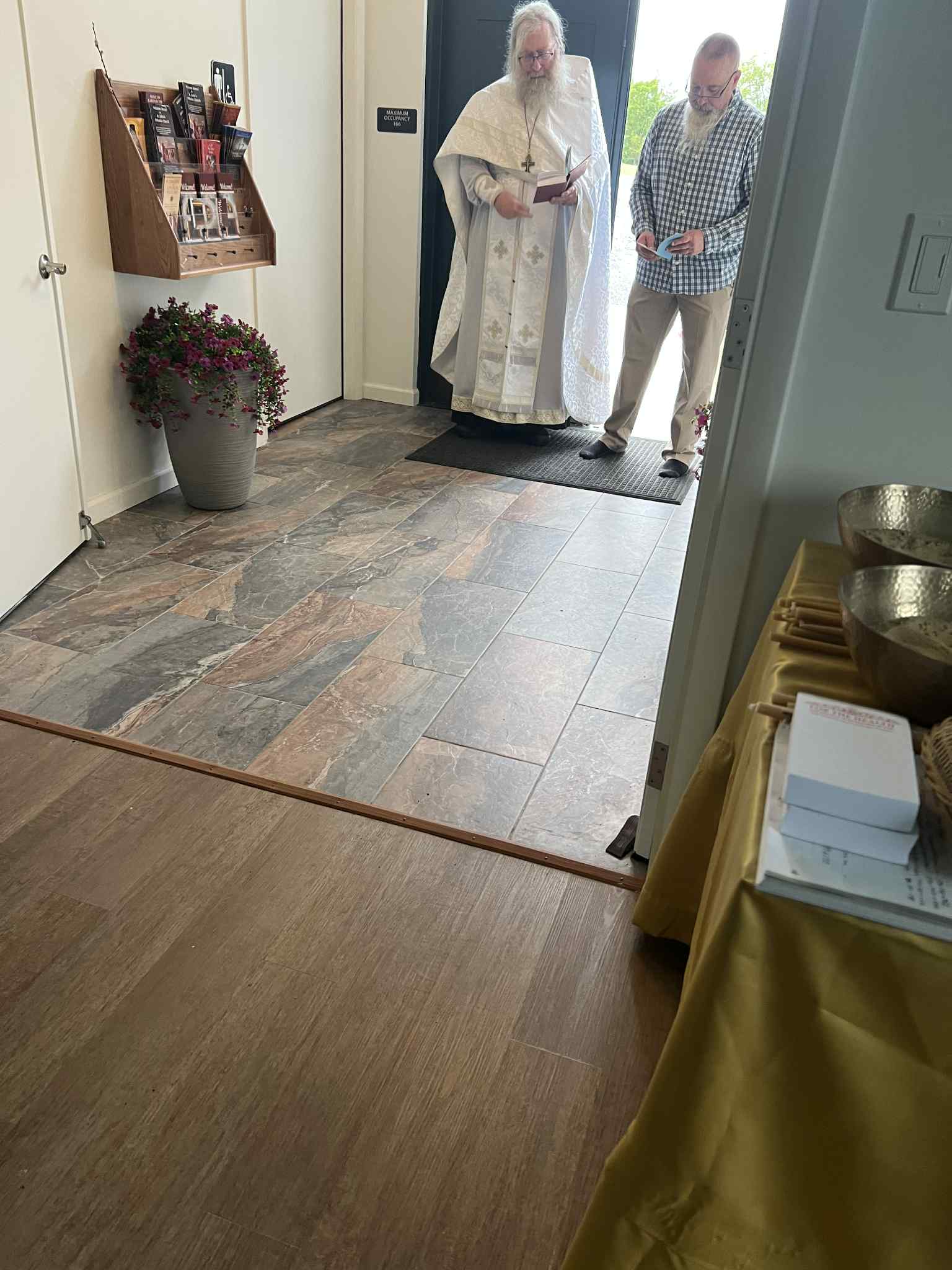
Above: A new catechumen entering the Orthodox Church at St. John’s
We are in the twilight of deep summer, a beautiful time in the overlap between the After Feast of Transfiguration and the Feast of the Dormition of the Mother of God, which we will celebrate Thursday. Friday we will have an Akathist to mark the Feast of the Icon not Made with Hands, the so-called nut feast because of the blessing of nuts, which marks the end of the Dormition Season, and the approach of the end of the Church Calendar year in September.
This season of mellow fruitfulness, an early harvest time overlapping with the first hints of autumn, reminds us of the gifts of God, to which we are also recalled by today’s Gospel (Matthew 18:23-35). God’s gifts to us, for which we are always wholly indebted and often terribly ungrateful, myself most of all, remind us to be forgiving and merciful with our fellows. Jesus Christ told us to love one another as He loved us. That is His new commandment. When we empty ourselves in Christ as we should do as Christians, we then can love one another more than ourself, in spiritual unity that in effect extends participation in Holy Communion across the week in our dealings with one another.
Saint John Chrysostom, who wrote the Liturgy we use on most Sundays as we did today, has written on this Gospel reading. He said (translation from Hieromonk German Cuba in The Gospel Commentary), the parable of the wicked servant “is dreadful and terrifying for transgressors of God’s commandments, but for those that keep them it is sweet and grace-filled…. We and all men are debtors in the sum of ten thousand talents, because we have received many good things from God and we ought to love Him greatly, yet instead we sin against Him…. “
St. John, a fourth-century saint renowned for his homilies on Scripture, notes that one talent of money among the Jews was equivalent to one gold pound, which today could be worth $40,000. So the servant owed the master in the parable the equivalent of perhaps $400 million today. The wicked servant has wasted his master’s wealth after having held a responsible position. St. John says his master’s initial punishment symbolizes a resulting alienation from God, a chastising of the flesh, and being handed over to Satan for affliction such as illnesses or demon-induced diseases. But, the servant pleads with the Lord, and St. John notes, “The Lord, a patient man, saw the servant’s contribution not being hardhearted, he was moved to mercy by the debtor’s entreaty. He freed him from a cruel fate; he forgave his debt completely, the entire sum of ten thousand talents.”
But then the wicked servant turns around and tortures a fellow servant who owed him a small amount, and showed no compassion, as he refused to forgive the fellow servant’s debt to him.
St John Chrysostom writes, “The good master and king reckons with the wicked servant and revokes his gift; or, rather he himself does not revoke it, for the gifts of God are irrevocable; it was repudiated by the man who did not show mercy to his fellow. O thou wicked servant, says the king. When he owed ten thousand talents, he did not call him wicked or chastise him, but forgave him; but when he showed himself unmerciful to his colleague, then the king says to him, Thou wicked servant…. he explains that the servant himself forfeited his former gift and afterwards incurred punishment.” This was because his lack of compassion is not only abominable before God it is displeasing to angels, and to men who are meek and good. Let us hear, who are unmerciful, and let us fear and tremble; let us understand that we are altogether condemning ourselves, rejecting the mercy shown us and inviting eternal torment. Let us hearken, who acquire riches unjustly; let us hearken, who are cruel and inhuman to our fellows and neibors. Let us hearken, who inhumanly extract repayment from debtors. Let us hearken, who exact usury; it is a wicked and evil deed, and proofing by usury is a most detestable act…. Let us hearken, who hold grudges and remember wrongs, and let us be afraid….
‘Seeing that we owe God so great a debt, if we do not show mercy to them that desire of us the forgiveness of small debts, we lose the pardon which God gave us when we prayed and entreated Him, and we shall mercilessly be required to answer for all our transgressions.”
So says St. John. Usury is participating in the charging of interest on debt. It can compound the debts we feel we are owed by others. Usury is condemned in the Bible and in Church canons for clergy, and discouraged for laity when both lending and borrowing become a way of life based in luxury and waste while oppressing others.
All to begin with is God’s gift to us of life. None of us is long for this world. When we die, we will not profit by usury or by its flip side in borrowing lazily, but rather our souls will be weighed down by it. Our entire economy today globally is based on usury, on compounding the debts of others, rather than having compassion and forgiveness, and debt binds us unforgiven in the Church. This is a spiritual problem even if we are never actually charging financial usury or participating in it. For spiritual usury is how we hold on to what we feel others owe us and let that grow in our sense of self-entitlement and our lack of compassion and even our desire for power over others. It can also involve a sense of getting something for nothing and blaming others for our sloth, without gratitude to God, but trying to game the system in effect to advance our worldly desires. Such spiritual usury is even worse than financial usury.
What helps us? The Lord’s Prayer notes “forgive us our debts as we forgive our debtors.” The Church offers us the spiritual medicine for this. The mystery of confession, by which we can rightly censure ourselves and take stock both of our own need for forgiveness by God and also of our need to forgive others their smaller debts to us, is the Church’s provision for freeing us from spiritual usury, to help us stop the toxic practice of compounding the debts we feel others owe us of one kind or another. It is a good time in this fasting Dormition season to renew our confessions. Indeed, fasting also is an accompanying way for us to recognize the need for our humility when seeking God’s forgiveness, provided by the Church. Finally, the fasting and feasts of this Dormition season, with the blessing of fruits, and of flowers, and of nuts, at three different times, remind us of the richness of God’s gifts to us.
“All good and perfect gifts are from above,” as the Scripture tells us. He gives us the gift of life, and we should live in the Church’s economy or household, which is a gift economy, not an economy based on either financial or spiritual usury. A gift economy is based on relationship, first with God, and then with one another, following Jesus’ new commandment to love one another more than ourself. This economy, based in faith, perhaps could be called based neither on communism nor capitalism, but on “mustard-seed economics,” to take a phrase from another parable of Jesus, which spoke of how faith as a grain of mustard seed grows with God’s grace and our nurturing care into a mighty tree. Our Lord told us not to worry about worldly things, but to seek first the Kingdom of God and His righteousness and all those needed things will be added unto us. So in the Lord’s Prayer we also are taught by Him to pray, “give us this day our daily bread,” which from the original Greek can also be translated, give us this day our “super-substantial” bread, a reminder of the mystery of the Eucharist, and how God feeds us and nurtures us from a dimension hidden to us that nonetheless has physical effects (a secular analogy might be the indication of a different dimension in quantum entanglement).
St. John ends his commentary on today’s Gospel reading by saying, “Let us spend our time in houses of God, and visit spiritul men. Let us forgive the little debts of our neighbors, whether it be a matter of money or contempt, or abusive words, or anything else, that we may receive a greater forgiveness from God and become heirs of His kingdom, of which we may all be counted worthy, in Christ Jesus our Lord, to Whom belong all glory, honor, and worship, together with His unoriginated Father and the most Holy, good, and life-giving Spirit, now and ever, and unto the ages of ages, Amen.”
A blessed After Feast of Transfiguration and Dormition Week to all!