(Above) A hand-painted icon of the Transfiguration of Our Lord created in the icon-painting studio of St Elisabeth Conven in Minsk, Belarus.
A Homily from St. John’s Russian Orthodox Mission Church, Lewisburg PA, for the Feast of the Transfiguration, 7532 (2024)
Today’s Feast in the Orthodox Church is one of 12 major feasts of the Church calendar, but it is not emphasized so much in heretical Western traditions. This is not surprising because it has central bearing on what are sometimes called the Eighth and Ninth Ecumenical Councils, which protect Orthodox Christianity from Western departures from it into heresy.
Councils Defending the Uncreated Light
The Eighth Council (Constantinople 879-880), sometimes referred to as the Photian Council, demonstrated the falsity of the filioque, an addition to the Creed in the patriarchate of Rome, which ended up riding that innovation into schism and heresy as Catholicism. It was a direction that Protestantism followed. The filioque in effect served to subjugate the Holy Spirit to a monadic God rather than the authentic Trinitarianism of Orthodox faith, falsely reducing the deep mystery of relationship in the All Holy Trinity. This led to an instrumentalist view of the Holy Spirit, in which the Holy Spirit in effect is controlled by a strange meld of the Father and the Son. A famous Western psychoanalytic theorist of Orthodox background, Julia Kristeva, proposed that this helped shape a strong sense of Western individualism, by which the self is put into a binary with the other. In Orthodoxy we don’t believe in psychologizing the Trinity, whose Essence is a mystery. But we can recognize that this has been a common false practice and underlying source of cultural symbolism in the West for a long time, with disastrous results. The binary of self and other in the West has shaped a cancellation of God’s Creation in effect as well, by turning the Earth into an object to be possessed, controlled, and remade, and with it humanity. Ultimately, this has become a power trip fueled by technology and scientific ideology now allied with neopaganism. The filioque veered into the Monophysitism found underlying Protestantism, and into the Unitarianism that infected so much of Western culture, then ultimately into first Deism, and now a techno-neopaganism exalting Luciferian will.
What is sometimes called the Ninth Council refers to councils in the fourteenth century (the two Councils of Sophia in 1341, and the Council of Blachernae in 1351) upholding St. Gregory of Palamas’ teaching, drawing on the earlier Church Fathers and Church Tradition, of hesychasm or the prayer of the heart and theosis, the union of the heart with God’s uncreated grace. St. Gregory of Palamas was doing battle with the scholasticism promoted by his opponent Barlaam, an Orthodox academic who later became a Roman Catholic bishop. Barlaam asserted that God was so mystically unknowable that there was no way that there could be an embodied presence for God’s energies, or an embodied prayer of the heart. Ultimately, Barlaam’s teaching was operating in a Western tradition, linked to the filioque, that came to emphasize a created sense of grace. Just as the Holy Spirit was subjugated to what became a placeholder for human will, so too grace became seen as created and likewise instrumentalist. If grace is created at will, then the modern world in replacing God with human individualism and rationalism sought in effect to control grace. Happiness became something regulated by technology, money, drugs, consumerism, and defined apart from God. Incidentally, even early Protestant philosophers, notably the Anglo-Irish minister Francis Hutcheson, tried to define happiness in virtuous terms related to God. His work influenced the wording of the Declaration of Independence in its famous promotion of “life, liberty, and the pursuit of happiness” as inalienable rights from God. However, that virtuous yet heterodox Christian perspective soon fell by the wayside, as heresies become ever more distant from Orthodoxy. Today, the term happiness in America means almost invariably in the public realm a sense of self-assertion and self-pleasing.
Such was the fruit of the error originally combatted by the Eighth and Ninth Councils, indicating how in Christianity a divergence from Orthodoxy becomes more and more severe and harmful across generations. Such is the importance of our Feast today, as exemolifying in Jesus Christ’s life on earth the uncreated energies of God, bearing the purpose of human life (happiness so to speak in the deepest sense) in theosis or participation with His grace, and in this a fully Orthodox sense of Trinitarianism. The energies are divine and express the unity-in-relationship of the Trinity as a whole. In Orthodoxy, following St. Basil the Great, natural law is considered the embodied spark of divine love in the human heart (as the late Dr. Herman Engelhardt put it). That spark expresses the uncreated energies, not an abstract grid of rules as in the Western sense of natural law historically.
(Below) The cloud that forms over the Orthodox monastery on Mount Tabor yearly at the Feast on the Julian Church calendar.

The Icon of the Holy Transfiguration of Jesus Christ
We see today in the icon before us at the top above, and in our liturgical worship the uncreated light from Jesus Christ on Mount Tabor, so wondrous to the Apostles who accompanied Him. Amid that uncreated light, the uncreated energies of grace from the Holy Trinity, Peter, James, and John could see Jesus with Moses and Elijah. Death and created time were no barriers for Him Who Is, the Way and the Truth and the Life. The divinity of the light was with the Apostles right in Creation. Jesus made it available to those followers who as holy people, saints, empty themselves in Him. This again was a divine yet physical presence, known to those who observed the uncreated light around holy people such as St. Seraphim of Sarov: Not an academic or technological exercise, but a sign of true theology in experience.
Such uncreated grace sustains us through the holy saints and elders of the Orthodox Church, and especially through the prayers of the greatest of saints, the Most Holy Theotokos, the first to achieve theosis most fully. They, and she most of all, are our intercessors for us as we ask Jesus Christ for mercy. We may not feel we have hope of theosis as sinners, myself most of all, but with their help we have strengthenedhope of salvation in Jesus Christ in the Orthodox Church. As St. Nikolai Velimirovich put it, I do not know if God will save a Catholic, but I know that if I left the Orthodox Church for Catholicism, I would not be saved. That is because the Orthodox Church is the true Church, upholding the fullness of the Trinity and the uncreated energies of God in Creation, from the ongoing uncreated light of Pentecost.
First Fruits from our “little churches”
This is why this Feast is so important to Orthodoxy. And it is also why we celebrate the blessing of the first fruits today, the blessing of fruits such as apples and grapes and others. For God’s Providence sustains us in embodied Creation through His uncreated energies, articulated by what St. Maximus the Confessor called the logoi of the Logos, the words of the Words. These are both the source of identity in Creation and of redemption in it by God’s grace. For the Greek word logos means not only word but purpose, reason, harmony, principle, connector–a spiritual ecology or network in a sense.
In our Bible Study yesterday, we talked about the Apostle Paul’s words to the Athenian philosophers, quoting a Greek poet about the Unknown God Paul declared to them, saying, “In Him we live and move and have our being.” This too speaks to the uncreated energies of God expressed in the logoi of the Logos in Creation. We reason rightly when we are in dialogue with the Logos, by emptying ourselves in the Logos, and participating in His grace. The Apostle Paul noted to the Athenians that we all have the same origin in God, we are descended from Adam and Eve in God’s Creation, but he added that we are in nations or peoples established by God to help ourselves find Him. This is not the solitary pursuit of the individual as promoted falsely by modernity. It is in the little churches of our families and homes, and in our Church family in our parish, that we find the faith and grow in Christ. This is because the Orthodox Church, the one Holy Catholic and Apostolic Church of the Creed, involves catholicity not merely in terms of universal or global space, but in terms of a deeply commonly rooted experience of place in solidarity in the Body of Christ, in the uncreated energies, which help shape us in communities of faith, too. That is the meaning of the Slavonic term sobornost or spiritual unity, which grew from a Slavic gloss on the Greek term for “catholic” in the Creed.
This mystical unity, deeply rooted in Christ, involves all the Creation, as we see in the blessing of the first fruits today. It is not secular globalization, which would turn the earth into a biological and mineral strip mine for profit, including humans as commodities. Rather, it is a recognition of how, as Paul put it, ‘The creation waits in eager expectation for the children of God to be revealed.’ As the Old Believer Orthodox philosopher Alexander Dugin put it, the creatures and even the natural elements of the earth, “await Christ. When He comes and accomplishes the great work of salvation, they cling to those who have followed Christ, like domestic animals — gently and faithfully.” So it was with for example with Russian saints and bears, Irish saints with water creatures, and also saints with plants. All this is a foretaste of Paradise restored and deepened in the coming of Christ, to which the Church offers a portal, our lifeline. His glory shall have no end. We give thanks for these first fruits.
Offering Ourselves
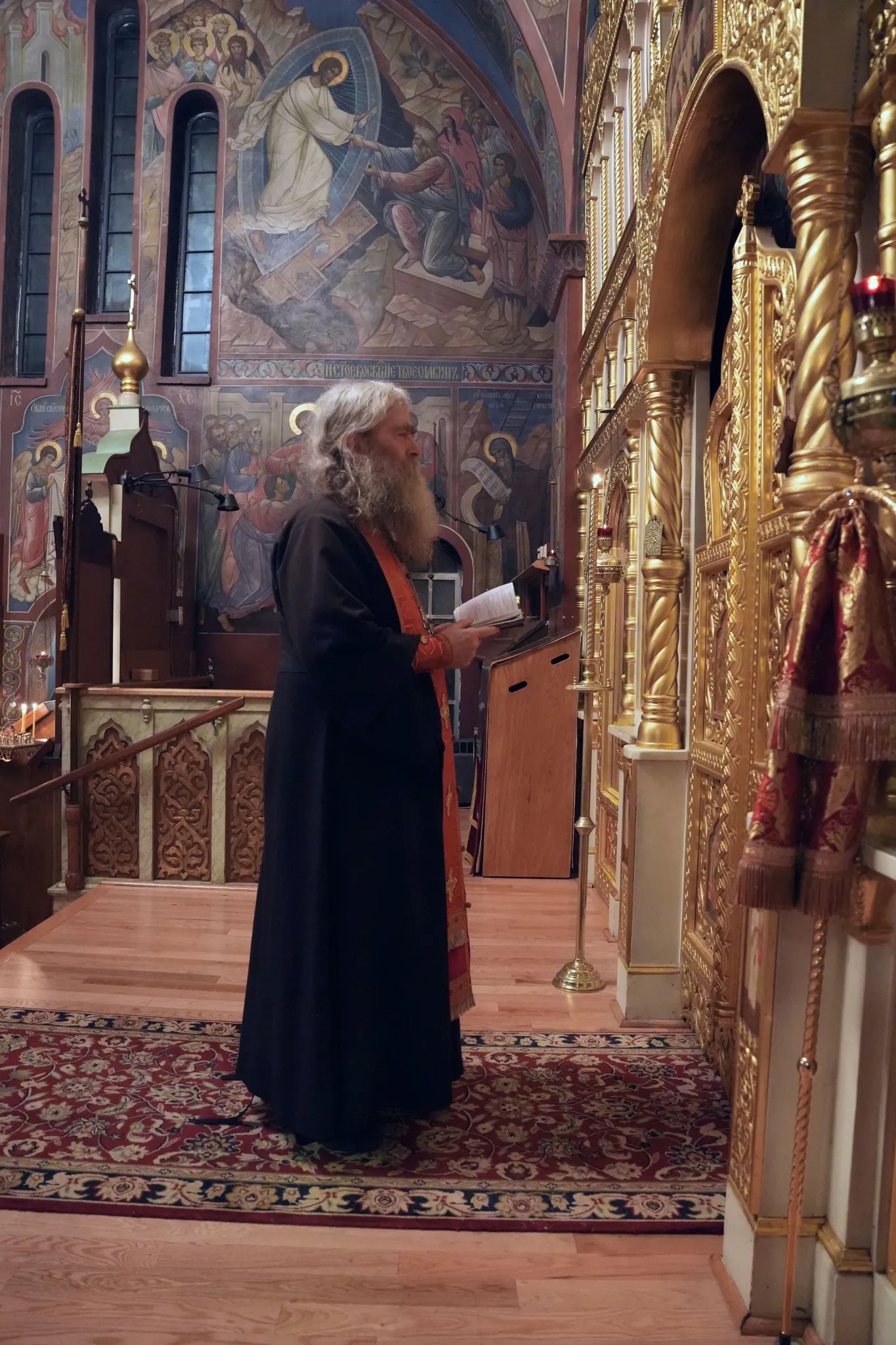
We also offer ourselves unworthily as fruits for sacrifice in this Feast. This is my first anniversary as an unworthy priest today. I truly am the worst of sinners, as the Pre-Communion Prayer states. When I was ordained, Bishop Luke whispered to me at the altar: Keep your zeal in the Holy Spirit and your humility so that you do not become proud in the priesthood. The Feast of the Transfiguration exemplifies both those lessons for us all in all the ways we all serve the Church, sometimes in hidden ways: (1) Zeal in the Holy Spirit, for through the experience of the saints we can know of the experience of the uncreated energies and even directly from God in the Church of Pentecost; and (2) humility to know that the Source is never ourselves and never about our own self-assertion but about our losing ourselves in Jesus Christ. God’s uncreated energies, His grace, reach out in loving embrace to each of us. For me, the prospect of becoming a Priest to serve the Church would have seemed an incredible out-of-reach miracle indeed when I first entered Orthodoxy more than 25 years ago this Sept. 1. To be formed as clergy unworthily but solely in traditional Orthodoxy in the Russian Orthodox Church Outside of Russia and the influence of traditional Greek monasticism, steeped in the teachings of the Councils, also has been an incredible blessing and legacy involving help from so many, thank God — from repeat visits to Jordanville for liturgical practice, and then my 40 days of priestly training serving the daily cycle there, earlier the ROCOR Pastoral School, and support from my spiritual father and the sisters of Holy Protection, as well as so many clergy–everyone at Jordanville, Father Claude and Father George at our mission, our Dean Fr. John and Fr. Nathaniel at our cathedral in Mayfield, Fr. David Straut, among many others–and most dear Matushka Olga and our sons Nicholas and Kevin Seraphim. I ask for your prayers that this sinful 1-year-old priest may nonetheless keep true to the fullness of Orthodoxy through God’s grace. Glory to God!
(Below) On my 40 days.